
Longevity science
Capacity ageing: why reserve, not years, decides how you age
Ageing is not the accumulation of years. It is the slow loss of spare capacity — the margin between what your body can do and what daily life demands of it. This is a plain-language look at where that margin goes, how to measure yours, and which interventions actually move it.
Two people arrive at sixty with identical medical records. One carries a suitcase upstairs without noticing. The other stops at the landing. Nothing in either chart explains the difference, because the difference is not disease. It is reserve — the gap between peak capacity and the demand of an ordinary day.
This is the most useful way to think about ageing, and it is almost never how it is described. You do not age into illness. You age out of margin.
What reserve actually is
Every organ is built with surplus. Your kidneys can lose most of their filtering capacity before blood tests change. Your lungs hold far more air than a conversation requires. Your heart at rest works at a fraction of what it can do. That surplus is the reason a young body absorbs a bad night, a missed meal or an infection without visible consequence.
Reserve declines from roughly the third decade onward, at about one per cent per year in most systems. The decline is invisible for a long time, because a body operating at forty per cent of capacity performs identically to one operating at ninety. You only discover the number when something demands it — a flight of stairs with luggage, a surgery, a fall, a virus.
This is why frailty appears to arrive suddenly. It does not. The reserve was drawn down over thirty years, and one ordinary demand finally exceeded what remained.
Six numbers that describe your margin
Reserve is not a single quantity, but it is measurable across several systems. These are the ones with the strongest links to how long people stay functional.
1. VO2 max — the aerobic ceiling
The maximum oxygen your body can use during hard effort. It is the single strongest predictor of all-cause mortality in the exercise literature, ahead of smoking status, hypertension and diabetes in several large cohorts. It falls about ten per cent per decade after thirty in untrained people, and roughly half that in people who keep training.
The practical threshold matters more than the number. Independent living requires somewhere around 18 ml/kg/min. Someone who peaks at 35 has decades of margin; someone who peaks at 24 has considerably less, and the same rate of decline takes them below the line far sooner.
2. Grip strength — the cheapest useful test in medicine
A hand dynamometer costs very little and predicts a startling amount: mortality, cardiovascular events, cognitive decline, recovery time after surgery. It is not that grip matters in itself. Grip is a proxy for total muscle quality and neuromuscular integrity, and it happens to be trivially easy to measure.
Muscle mass peaks in the twenties to thirties and declines roughly three to eight per cent per decade after that, accelerating after sixty. The loss is not evenly distributed — fast-twitch fibres, the ones responsible for catching yourself when you stumble, go first.
3. NAD+ — the cellular energy substrate
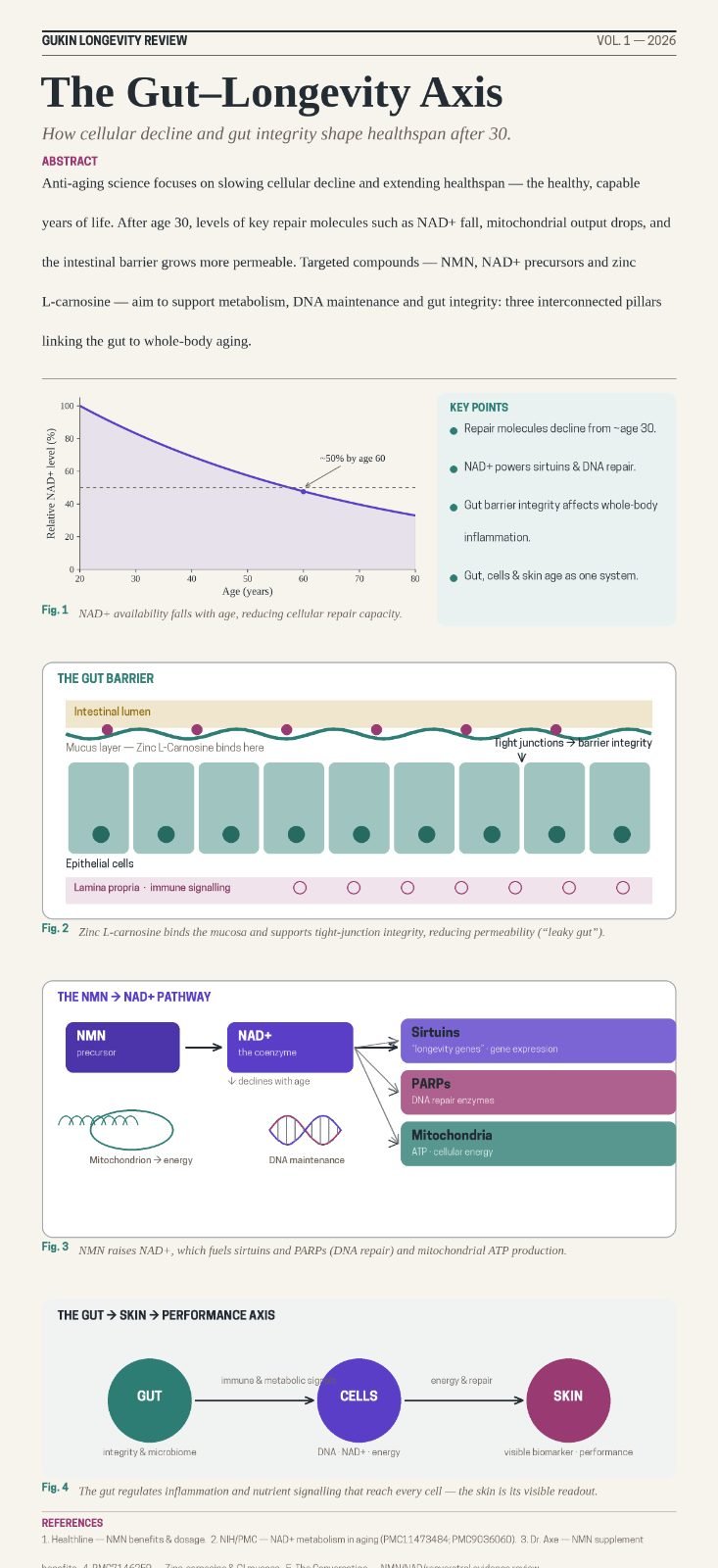
NAD+ is the coenzyme mitochondria use to convert food into usable energy, and the obligatory substrate for the sirtuins and DNA-repair enzymes that maintain cells. Levels can fall by roughly half by mid-life.
There is a competition worth understanding here. DNA damage activates repair enzymes called PARPs, which consume NAD+. The more damage accumulates, the less NAD+ remains for energy production and maintenance — a feedback loop where wear produces less capacity to repair wear.
4. Gut barrier integrity — the upstream variable
The intestinal lining is one cell thick. When its tight junctions loosen, bacterial fragments enter circulation and the immune system responds with persistent low-grade inflammation — the state researchers call inflammaging.
This is the most consequential item on the list, because it feeds every other one. Chronic inflammation degrades muscle protein synthesis, suppresses the growth factors behind neuroplasticity, accelerates collagen breakdown and worsens insulin sensitivity. Fix the barrier and you remove an input to four downstream declines rather than treating four symptoms.
5. Cognitive reserve — the redundancy you build
Two brains with identical pathology can present completely differently. Cognitive reserve describes the capacity to sustain damage before function fails, and it is built rather than consumed: through education, occupational complexity, bilingualism, musical training and dense social networks.
The mechanism is thought to be redundancy — more alternative routes through the network means more damage tolerated before a route is lost. It appears to keep accruing throughout life, which makes it the one item here that responds to a decision made this year.
6. Recovery rate — reserve, observed directly
How long it takes to return to baseline after a hard session, a poor night or an illness. It is rarely measured formally and it is possibly the most honest signal available, because recovery is reserve being spent and replaced in real time.
The common early sign of declining margin is not reduced peak performance. It is the same peak taking three days to recover from instead of one.
Facts worth carrying
Healthspan gap
More than a decade
Across most populations the gap between lifespan and healthspan — years lived versus years lived well — averages over ten years. Closing it is more tractable than extending the total.
Modifiable risk
Around 40 per cent
Roughly forty per cent of dementia risk is attributed to modifiable factors, hearing loss and midlife hypertension among the largest. Not all of ageing is negotiable, but a substantial share is.
The silent window
Twenty to thirty years
Neurodegenerative pathology accumulates for two to three decades before symptoms appear. Bad news for late intervention; unusually good news for early intervention.
Immune load
Around 70 per cent
Roughly seventy per cent of immune tissue sits along the intestinal wall. This is why gut barrier integrity is an immunological variable, not merely a digestive one.
What actually moves the numbers
Ranked by the strength of the human evidence, not by how interesting the mechanism is.
Tier one — large, well-replicated effects
- Resistance training. Two to three sessions weekly. The only intervention that reliably rebuilds muscle reserve at any age, including in the ninth decade. Nothing else on this list substitutes for it.
- Aerobic exercise. Roughly 150 minutes weekly at moderate intensity. Raises VO2 max, preserves hippocampal volume, improves insulin sensitivity, raises BDNF.
- Sleep, seven to nine hours, consistently timed. Growth hormone release, collagen synthesis, glymphatic clearance of metabolic waste and memory consolidation all run on the night shift. No supplement compensates for its absence.
- Blood pressure control in midlife. Among the clearest modifiable predictors of both cognitive and cardiovascular outcomes, and largely silent until it is not.
- Protein sufficiency. Roughly 1.2 to 1.6 g per kg of body weight for adults maintaining muscle, higher than most guidelines and considerably higher than most actual intake.
- Hearing correction. Untreated hearing loss is one of the largest single risk factors for cognitive decline, and correcting it is straightforward.
Tier two — plausible, human data thinner
- Gut barrier support. Zinc L-carnosine and L-glutamine have reasonable mechanistic and clinical support for barrier integrity, and the downstream inflammatory argument is strong.
- NAD+ precursors. NMN and NR reliably raise blood NAD+. Whether that translates into functional benefit in healthy adults is not yet established.
- Magnesium. Insufficiency is common; correcting it improves sleep architecture, which is itself tier one.
- Omega-3 phospholipids. Clearest benefit in people starting deficient; membrane building is a materials constraint rather than a performance input.
Tier three — mechanism only
Senolytics, most peptide protocols, high-dose single antioxidants. The mechanisms are genuinely interesting and the human outcome data is absent. Mechanism is a reason to watch a compound, not a reason to buy it as an outcome.
Why earlier is disproportionately better
Reserve compounds. A thirty-five-year-old who raises VO2 max by five points is not five points better off — they have shifted the entire subsequent decline curve upward, and they have thirty years for that shift to matter. The same five points gained at seventy is worth having and worth considerably less.
This is the argument for acting in the decade where nothing appears to be wrong. Reserve is only visible in its absence, which means the years when intervention pays most are precisely the years when it feels least necessary.
What this does not mean
No supplement stops ageing, and we will not tell you otherwise. What the evidence supports is narrower: correcting a deficiency, restoring a declining precursor, reducing chronic inflammatory load. Those are real, measurable, and modest next to sleep and training.
Nor is reserve entirely within your control. Genetics, early-life conditions and access to care all set the starting point. The useful question is not whether ageing can be defeated, but how much of your own margin is still negotiable — and for most people, at most ages, the answer is more than they assume.
This article is education, not medical advice. It is not intended to diagnose, treat, cure or prevent any disease. Speak to a physician before changing medication or starting a new regimen.
Where GUKIN fits
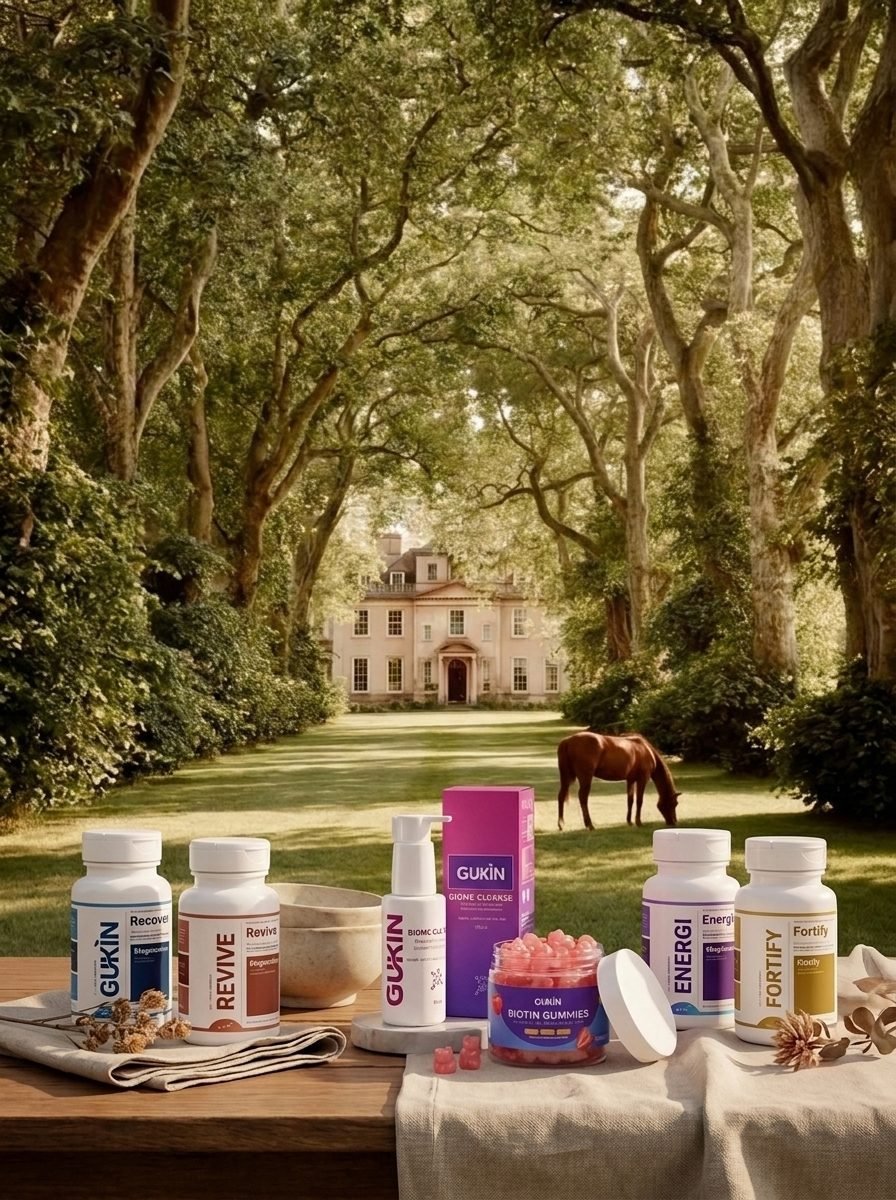
Our range addresses two items on the list directly. BIOME CLEANSE and the Gut Restore Synbiotic target barrier integrity, the upstream variable. Energize. and Revive. address the cellular-energy pathway through NAD+ and its precursors. Recover. supports the sleep architecture that everything else depends on.
None of it replaces the training, and we would rather say so.
Keep reading

Cellular science
NAD+ depletion and the energy of ageing
Why the coenzyme at the centre of cellular metabolism falls by half, and what that costs.
Microbiome science
The gut–longevity axis
How intestinal permeability drives the inflammation that accelerates everything downstream.
Neuroscience
The brain, treated as biology
Neuroplasticity, metacognition and cognitive healthspan, in seven pieces.