
Microbiome science
The gut–longevity axis: why ageing starts in your intestines
How intestinal permeability drives the low-grade inflammation that accelerates collagen loss, insulin resistance and cognitive fog — and what repairs it.
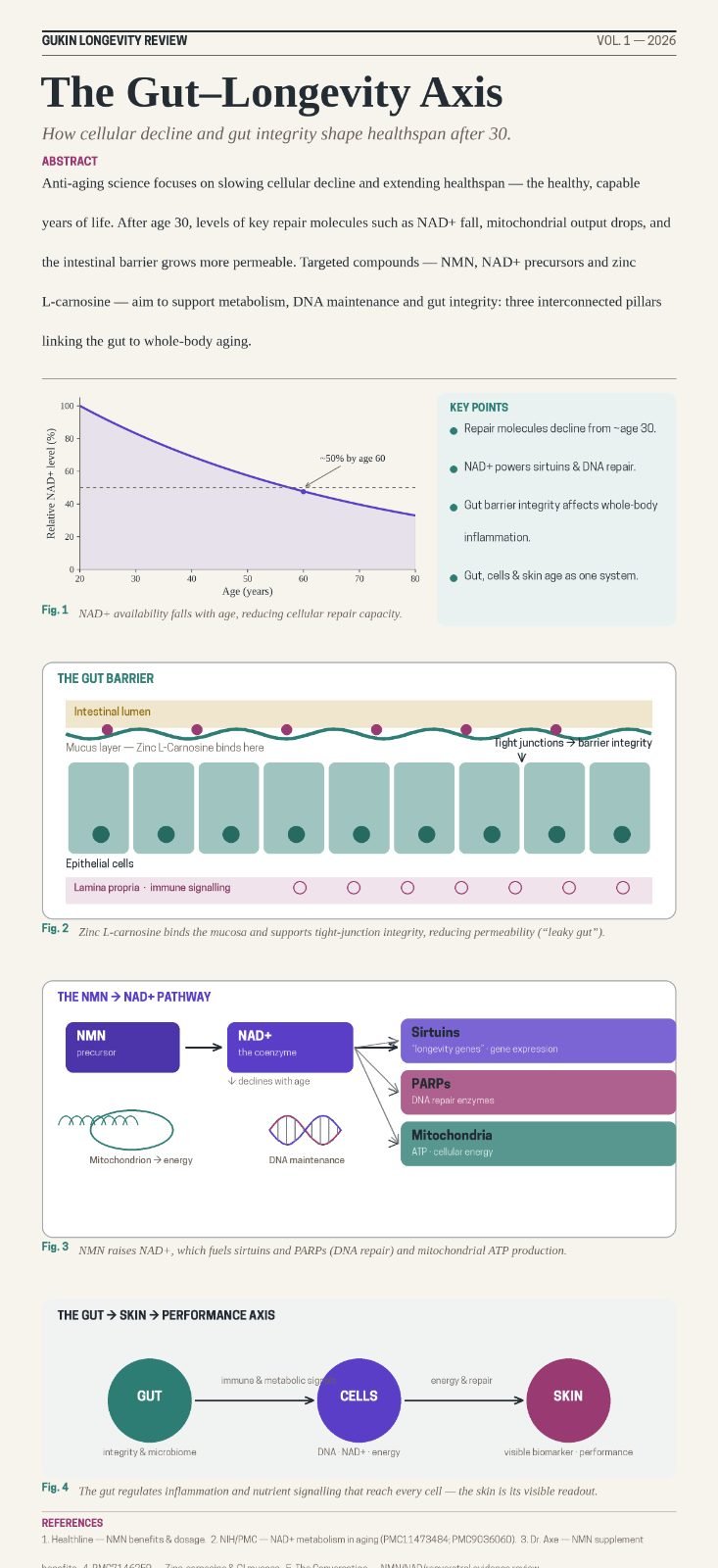
Ask most people where ageing happens and they will point at their face. The more useful answer is a metre lower down, in a single layer of cells lining the small intestine — a barrier roughly one cell thick, separating the bloodstream from several kilograms of bacteria.
The barrier is one cell thick
That lining is held together by protein complexes called tight junctions. When they hold, nutrients pass through in a controlled way and bacterial fragments stay out. When they loosen — from chronic stress, alcohol, NSAIDs, ultra-processed diets, or simply a depleted microbiome — those fragments cross into circulation.
The most studied of them is lipopolysaccharide, or LPS, a component of the outer wall of gram-negative bacteria. In the gut it is harmless. In the bloodstream the immune system reads it as an invading infection and mounts a response. The response is small. It is also constant.
Why constant beats acute
Acute inflammation is useful: it clears an infection and resolves. Chronic low-grade inflammation never resolves, and the cost compounds. Three consequences matter most for how you age:
- Collagen. Inflammatory cytokines upregulate matrix metalloproteinases, the enzymes that break collagen down, while simultaneously suppressing the fibroblast activity that builds it. The net balance shifts toward loss. This is why skin can look tired in someone who sleeps adequately and uses good topicals.
- Insulin sensitivity. Inflammatory signalling interferes with insulin receptor cascades in muscle and liver. The result is a slow drift toward insulin resistance independent of body weight — which is why lean people are not automatically metabolically healthy.
- Cognition. The prefrontal cortex is unusually sensitive to inflammatory load, and chronic inflammation suppresses BDNF, the growth factor underpinning neuroplasticity. The subjective experience is not memory loss but a loss of judgment about your own capacity — you feel able to do less, and you assess it less accurately.
This is why we treat gut, skin and cognition as one pathway rather than three product categories. They share an upstream cause, so they respond to an upstream fix.
What the microbiome contributes
The bacteria are not passengers. Fermenting dietary fibre, they produce short-chain fatty acids — butyrate chief among them — which are the preferred fuel of the colonocytes lining the gut wall. Butyrate feeds the barrier that keeps the bacteria out. Starve the microbiome of fibre and you starve the barrier.
Diversity is the marker that tracks most consistently with healthspan, and it is responsive: measurable shifts follow dietary change within days. A narrow diet narrows the ecosystem, and a narrowed ecosystem produces less of what the barrier needs.
What actually repairs it
The evidence is strongest for a short list.
Zinc L-carnosine is a chelated form studied specifically for mucosal integrity, with better retention at the gut wall than generic zinc salts. L-glutamine is the primary fuel of enterocytes and becomes conditionally essential under physiological stress. Fermentable fibre — inulin, resistant starch, the fibre in vegetables and legumes — feeds butyrate production. Polyphenols from berries, olive oil, tea and cocoa act as prebiotic substrate and shift microbial composition.
Against those, the things that erode the barrier are equally clear: chronic alcohol, habitual NSAID use, sustained psychological stress, and diets built on ultra-processed food and emulsifiers.
The order of operations
None of this is fast. Digestive comfort usually shifts within two weeks. Energy and focus follow at three to five. Skin runs on its own renewal cycle of roughly twenty-seven days, so allow eight to twelve weeks before judging it — anything quicker is hydration, not structure.
The sequence matters more than the speed. Repair the barrier, feed the ecosystem, and the downstream systems stop fighting an inflammatory headwind. Everything else you do — training, sleep, topicals, NAD+ support — works better once that headwind drops.
Keep reading
Longevity science
NAD+ depletion: the quiet reason forty feels different
6 min read

Dermal biology
PDRN and peptides: signalling repair rather than adding moisture
5 min read

Recovery science
Sleep, magnesium and the repair window you are probably wasting
6 min read
Written for education. Mechanisms described reflect published research on these compounds. Food supplements are not intended to diagnose, treat, cure or prevent any disease. Consult a physician before starting any supplement.