
Dermal biology
PDRN and peptides: signalling repair rather than adding moisture
Most skincare hydrates. A smaller category instructs fibroblasts to rebuild. The difference between occlusion and signalling, explained.

Almost everything sold for skin does one of two things: it adds water, or it stops water leaving. Both are useful and neither is repair. A third, much smaller category does something different — it sends a signal.
Hydration is not structure
Hyaluronic acid holds many times its weight in water and plumps the surface within hours. Ceramides and fatty acids restore the lipid mortar between corneocytes, reducing transepidermal water loss. Together they explain most of what a good moisturiser achieves, and the effect is real — a well-hydrated barrier looks and behaves better.
But it is a state, not a change. Stop, and it reverses within days. The structural elements that determine how skin ages — collagen density, elastin integrity, the rate at which damage is repaired — sit deeper, in the dermis, and are controlled by fibroblasts.
What fibroblasts respond to
Fibroblasts build collagen and elastin. Their activity is not constant; it rises and falls with the signals reaching them. In youth those signals arrive readily. With age, and under inflammatory load, fibroblasts become quieter and less responsive.
Two ingredient classes are studied for waking them.
Peptides are short chains of amino acids that act as messengers. Signal peptides mimic fragments of broken collagen — the body reads the fragment as evidence of damage and initiates synthesis. Carrier peptides deliver trace minerals such as copper, required cofactors for the enzymes that cross-link new collagen. The mechanism is not to supply building material but to instruct the cell that building is required.
PDRN — polydeoxyribonucleotide — is a fraction of low-molecular-weight DNA that engages adenosine A2A receptors on fibroblasts. That engagement is associated in the literature with increased fibroblast proliferation, greater collagen synthesis and reduced inflammatory signalling. It emerged from wound-healing research, where the objective is closing tissue rather than improving appearance.
That origin is the point. Everyday barrier turnover and wound healing run on the same pathway. An ingredient that accelerates repair after injury acts on the process that also governs how quickly skin recovers from a sunburn, a breakout or a winter.
Why it is formulated alongside, not instead
Signalling repair on a compromised barrier is inefficient. A disrupted barrier is inflamed, and inflammation is exactly what suppresses fibroblast activity — you would be issuing instructions while sustaining the interference that drowns them out.
So the sequence is barrier first, signal second. Ceramides and hyaluronic acid restore the environment; PDRN and peptides operate within it. This is the same logic as the gut: repair the boundary, then improve what happens behind it.
What to expect, and when
Hydration shows in days. Structural change follows skin's own turnover cycle of roughly twenty-seven days, and meaningful collagen change requires several cycles — eight to twelve weeks minimum, with continued gains beyond that. Anything advertising a structural result in a fortnight is describing water.
One more thing worth saying plainly: sun protection outperforms every ingredient discussed here. Ultraviolet exposure is the single largest driver of collagen degradation available to you, and it is the one you can eliminate almost entirely. Repair ingredients are worth using. They are worth much more used behind daily SPF.
Keep reading
Microbiome science
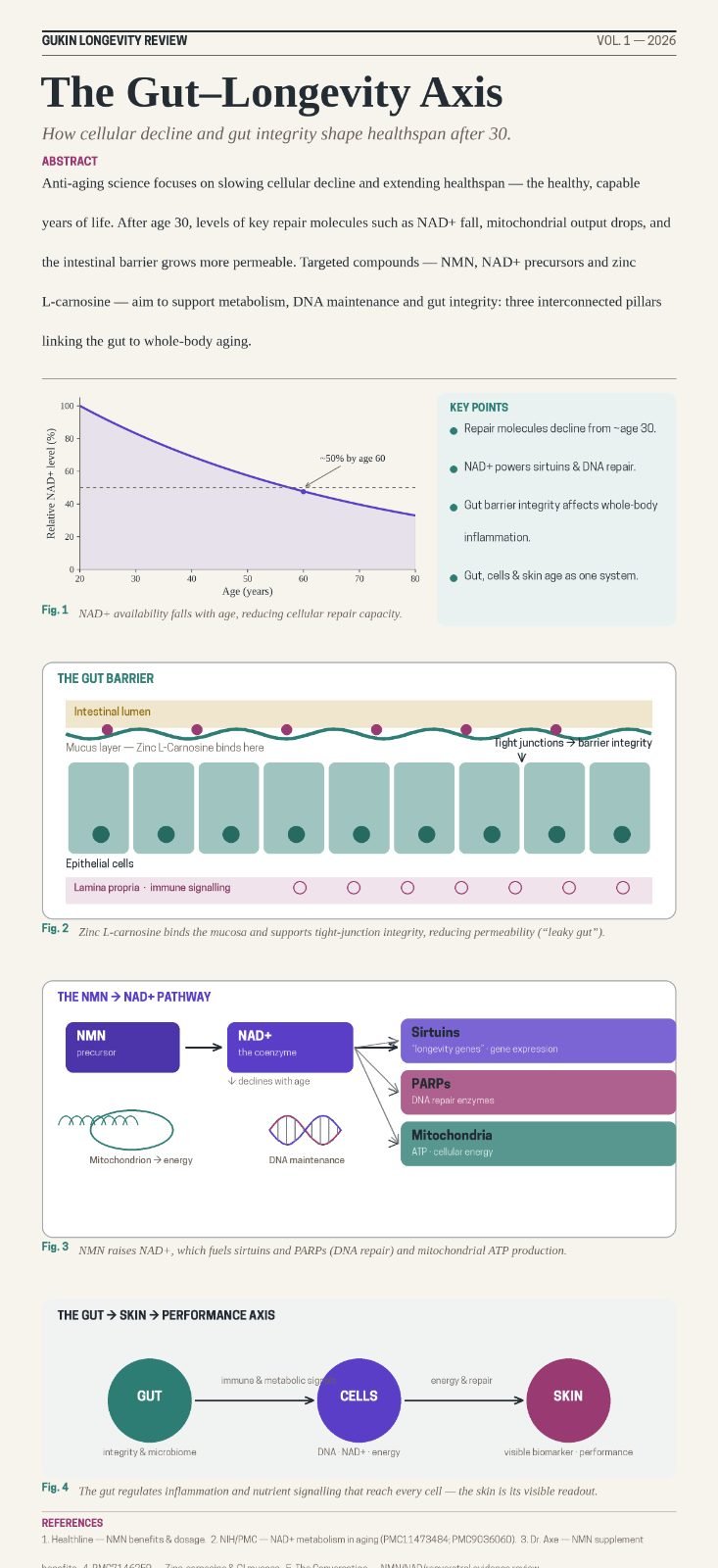
The gut–longevity axis: why ageing starts in your intestines
7 min read

Longevity science
NAD+ depletion: the quiet reason forty feels different
6 min read

Recovery science
Sleep, magnesium and the repair window you are probably wasting
6 min read
Written for education. Mechanisms described reflect published research on these compounds. Food supplements are not intended to diagnose, treat, cure or prevent any disease. Consult a physician before starting any supplement.