Longevity science
NAD+ depletion: the quiet reason forty feels different
NAD+ levels can fall by half by mid-life. What the coenzyme does, why it declines, and whether NMN supplementation is worth the money.
There is a specific kind of tiredness that arrives somewhere in the late thirties and does not respond to sleep. You go to bed early, you wake up, and the afternoon still collapses. The usual explanations — stress, age, children — describe the circumstance without explaining the mechanism.
What NAD+ actually does
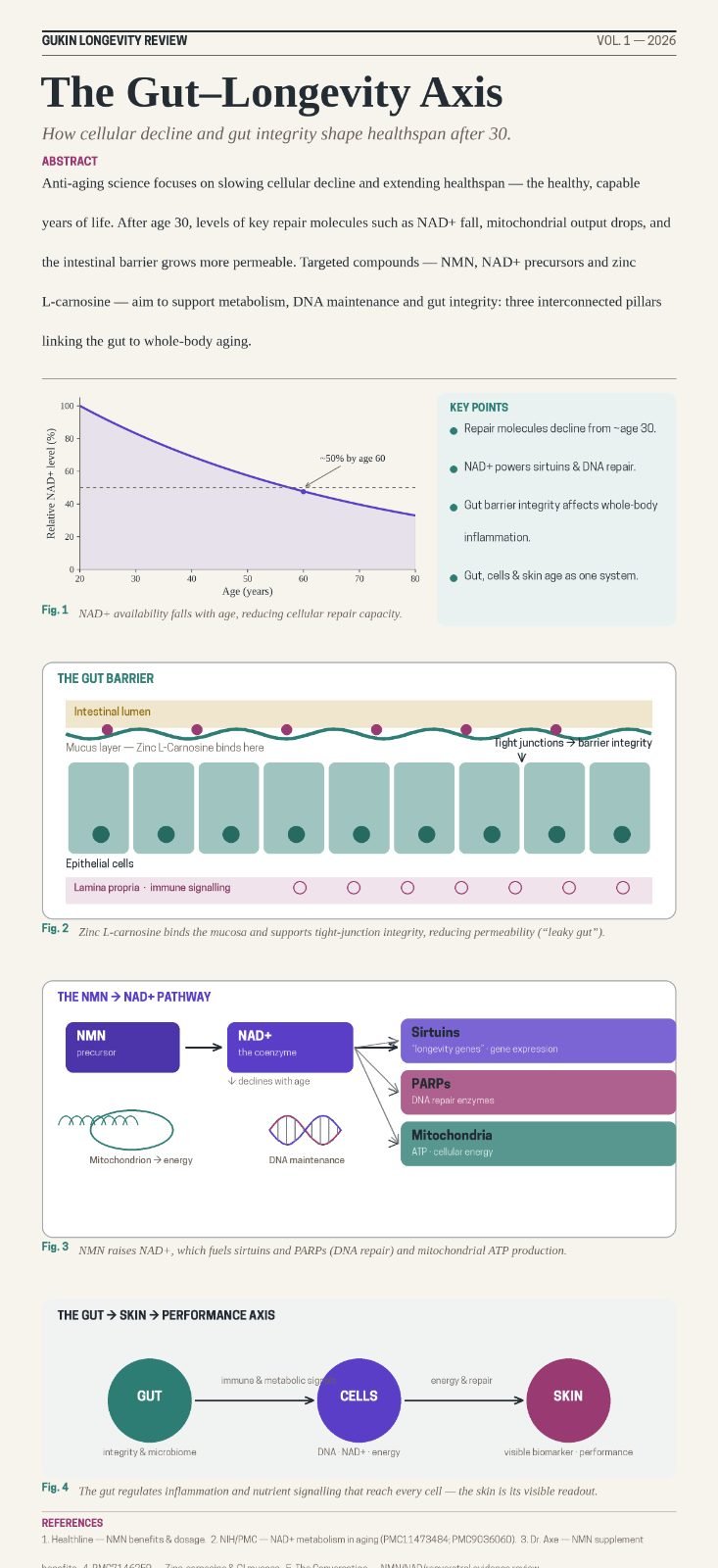
Nicotinamide adenine dinucleotide is a coenzyme present in every cell you have. It does one thing, relentlessly: it carries electrons. In the mitochondria that makes it the vehicle by which food becomes ATP, the molecule that powers everything from muscle contraction to protein synthesis.
But energy is only the first job. NAD+ is also the required substrate for two enzyme families central to ageing:
- Sirtuins — regulators of DNA repair, mitochondrial biogenesis and inflammatory tone. They cannot function without NAD+ as a cofactor. Not less well: not at all.
- PARPs — the enzymes that repair DNA strand breaks. Each repair consumes NAD+, so accumulated DNA damage actively drains the pool that sirtuins also need.
That competition matters. Under high damage load, PARPs consume NAD+ aggressively, and sirtuin activity falls as a side effect. Cellular repair and cellular regulation are drawing on the same account.
Why it falls
NAD+ levels decline with age across every tissue measured, with estimates commonly around a fifty per cent reduction by mid-life. Two forces drive it: synthesis slows, and consumption rises. The salvage pathway that recycles NAD+ becomes less efficient, while accumulated DNA damage and rising inflammation increase demand. Chronic inflammation is a particularly efficient drain, which is one more reason gut barrier integrity turns up in a conversation ostensibly about energy.
The practical consequence: below a certain NAD+ availability, the cell prioritises immediate energy production over maintenance. Repair gets deferred. Deferred long enough, deferral is what ageing looks like.
Can you raise it?
You cannot usefully take NAD+ itself — the molecule is too large and charged to cross cell membranes intact, and most of an oral dose is degraded before it arrives. Precursors are the route.
NMN (nicotinamide mononucleotide) sits one enzymatic step from NAD+ and has been shown in human trials to raise blood NAD+ levels. NR (nicotinamide riboside) enters a step earlier and is similarly supported. Both work. The honest summary of the literature is that raising NAD+ is well established; translating that into measured healthspan outcomes in humans is still an open question with promising early data.
What is not in doubt is the direction. Restoring a precursor that has measurably declined is a more defensible proposition than most of what the supplement industry sells.
Why resveratrol keeps appearing beside it
Raising NAD+ supply addresses only half the equation. Sirtuins still need activating. Trans-resveratrol is a sirtuin-activating compound, which is why it is formulated alongside NMN rather than instead of it — more substrate and more enzyme activity, rather than one without the other. Quercetin and CoQ10 are commonly added for a related reason: senolytic activity and electron-transport support respectively, both operating on the same mitochondrial economy.
What matters more than the supplement
Three interventions raise NAD+ without costing anything. Exercise — particularly resistance training and high-intensity intervals — upregulates the salvage pathway directly. Time-restricted eating raises the NAD+/NADH ratio. And reducing chronic inflammation lowers PARP demand, leaving more of the pool available for maintenance.
A precursor supplement is worth taking. It is worth considerably more taken alongside those three than instead of them.
Keep reading
Microbiome science
The gut–longevity axis: why ageing starts in your intestines
7 min read

Dermal biology
PDRN and peptides: signalling repair rather than adding moisture
5 min read
Recovery science
Sleep, magnesium and the repair window you are probably wasting
6 min read
Written for education. Mechanisms described reflect published research on these compounds. Food supplements are not intended to diagnose, treat, cure or prevent any disease. Consult a physician before starting any supplement.